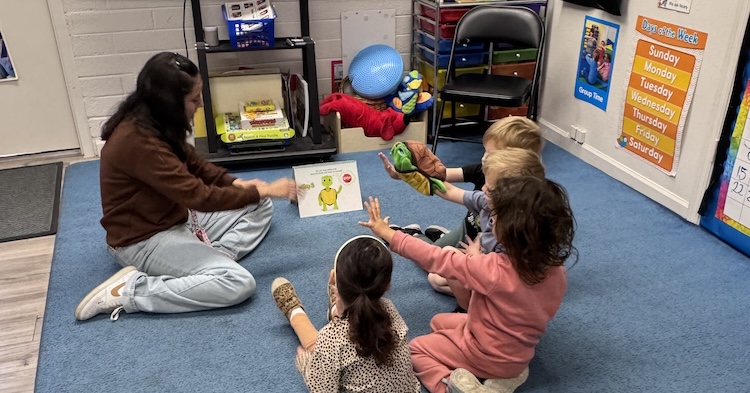
In one early learning program in the First Things First Phoenix North Region, children are learning how to build friendships and solve problems together—skills that will stay with them long after preschool.
Kathy Grandprey, the director of Hope Church Preschool, says their work with the Pyramid Model has helped them take their quality to the next level.
What is the Pyramid Model?
The Pyramid Model is a framework that helps early childhood programs support young children’s social- emotional development. It is based on research and used in preschools and child care programs.
The model builds on support from the bottom up:
- First, it focuses on caring, well-trained adults who build strong relationships with children and families.
- Next, it helps teachers create environments that are safe, predictable and supportive.
- Then, children learn skills like problem-solving, making friends and handling big feelings.
- Finally, there is extra support for children who need more help.
The goal of the Pyramid Model is to encourage positive behavior, reduce challenging behavior and support inclusion, while guiding adults in how to support young children.
Strengthening inclusion with the Pyramid Model
When Grandprey first introduced the Pyramid Model to her staff, she knew it would be a big commitment. “I’m really proud of my staff for taking on the Pyramid Model. It’s a lot.” she said.
The preschool was already focused on inclusion. In addition to participating in Quality First, they participate in the Inclusion program and Early Childhood Mental Health Consultation, funded by First Things First. So, when the opportunity came to join the Pyramid Model cohort through the Arizona Department of Education, it felt like a natural fit.
“Our goal is for children to leave us and go to Kindergarten as confident learners who can be part of a group.” For Grandprey, that confidence matters far beyond preschool.
“I know adults who don’t play well with others. So if we can teach them how to do that when they are five, how much better equipped will they be for the rest of their lives?”
Seeing the child, not just the behavior
For Hope Church Preschool, the Pyramid Model helped them build on how they supported children with special needs and further strengthen those practices.
“I think for us, for our program, it was a matter of teaching teachers how to look at children as individuals. I think sometimes adults only see the behavior, they don’t see the child,” she explained.
Through training and coaching, teachers learned to see children as individuals, especially children with special needs.
“That’s where our training, and our inclusion coach and mental health consultant have been a big part of making this an inclusive program. And of course, all that comes to us through Quality First,” she said.
Grandprey wants every child to be seen and valued for who they are.
“We are a faith-based program, so for me, that’s a big part of our program, that these children know they are loved. By us, and by God.”
Teaching children to solve problems
One of Grandprey’s favorite examples of the Pyramid Model in action happened in the Pre-K classroom.
The Pyramid Model includes simple tools, like picture cards, that show children different ways to solve a problem. One day, she watched as the children used those tools on their own.
“One of the kids holds up a picture card and says, ‘We have a problem!’, and a group of children gathered around, asking, ‘What’s the problem?’ and, ‘How are we going to solve this?’”
Instead of waiting for a teacher to step in, the children worked together to find a solution.
“This program helps us empower the children to solve their problems.”
Grandprey says moments like this happen often. “It is the children initiating it most of the time.”
Everyone has to be on board
Grandprey believes successful change requires a shared commitment.
Her advice is simple: “It won’t work unless everyone is on board.”
She recalled that when sharing the idea of joining the Pyramid Model with her staff, one teacher asked a simple question: “Isn’t this going to make us better?”
Grandprey told her yes.
“And she said, ‘Then let’s do it.’”
Today, the program is thriving and adding new families. Through Quality First, Pyramid Model, Inclusion support and Mental Health Consultation, the team at Hope Church Preschool are helping children build confidence, friendships and skills that will last well beyond preschool.